


Building a ‘Palace in Time’

Lisa Edelstein and Robert Russell Turn Memory Into Art
By Ayala Or-El
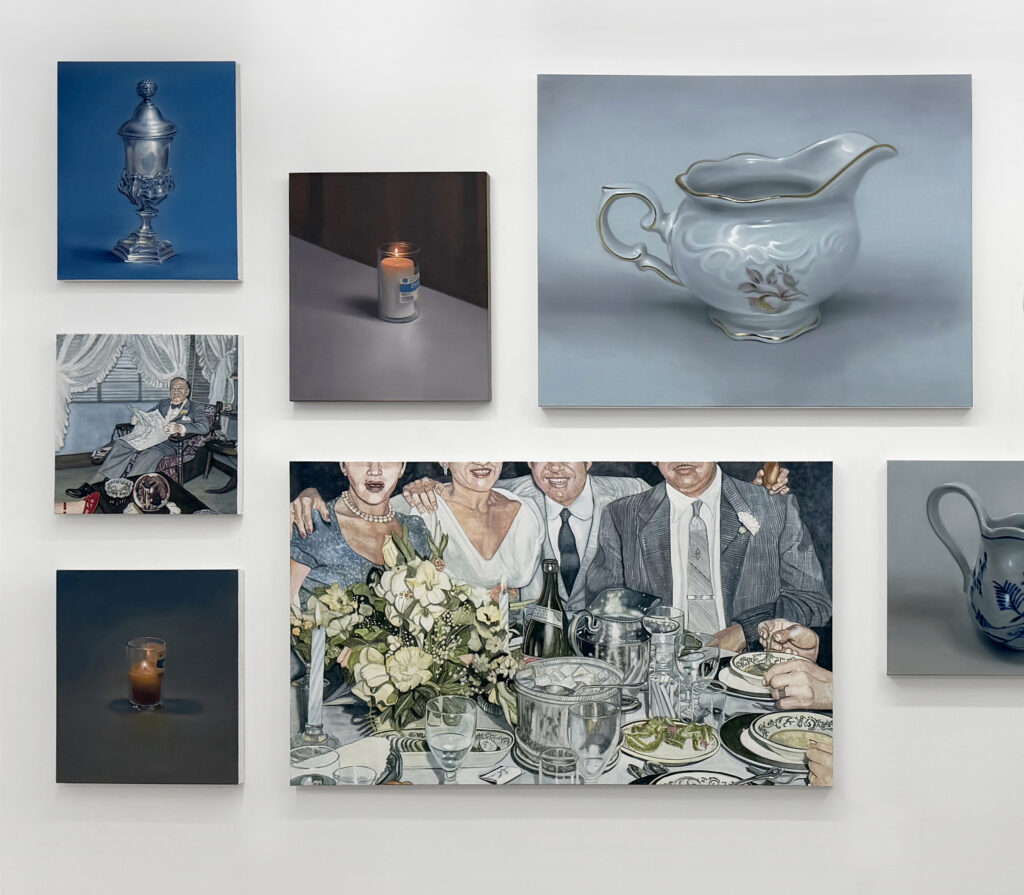
Step into a living room frozen in time, where family dinners, Sabbath candle lighting, and fleeting moments of joy and grief coexist in vibrant colors and delicate detail. This is the experience awaiting visitors to ‘Palace in Time,’ the upcoming joint exhibition by actress-turned-artist Lisa Edelstein and her husband, renowned painter Robert Russell, at the Skirball Cultural Center (May 20–September 6).
Drawing on vintage family photographs from the 1970s and ritual objects from Jewish communities past, the couple captures the textures of everyday life—the laughter, the tension, the ordinary and the sacred—creating a space where memory and ritual intertwine and the personal becomes universal.
Skirball curator Vicki Phung Smith first encountered Edelstein’s exhibition Dance Me to the End of the World at the Charlie James Gallery. Two months later, she visited Russell’s show at Anat Ebgi Gallery. After subsequently touring the couple’s Los Angeles home studio, she began to see a clear connection between their work.
“Between these two exhibitions and being invited to do a studio visit with Robert and Lisa at their home, I thought it was really interesting that while both of their works are different, they had the same themes and ideas. I realized they were in dialogue with each other,” said Smith. “They also mentioned that following the events of October 7, they wanted to make work that spoke to their Jew ish identity. That was, in a way, a form of resistance and an action they wanted to take at a time when it didn’t feel safe to be Jewish.”
Smith noted that in the art world, Jewish artists are not always explicit about their identity in public — a context that made the couple’s exploration of Jewish ritual and memory all the more significant.
Shortly after that visit, she emailed the couple and invited them to do a joint exhibition.
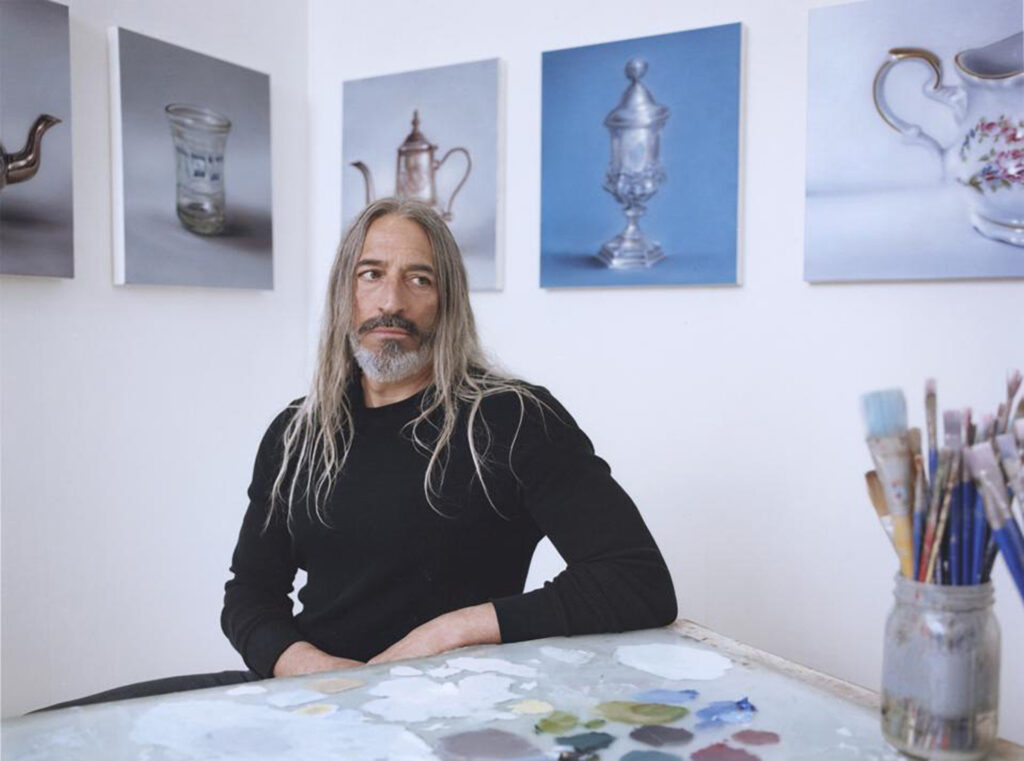
Russell, a contemporary artist whose still-life paintings depict Jewish ritual objects such as Kiddush cups and yahrzeit candles, said he had never collaborated with another artist on an exhibition before but was thrilled to share the space with his wife.
“I think we’ve created something really beautiful, and now we’re sort of taking our victory lap, getting to see how it lives in the world,” he said.
Edelstein, a well-known actress who appeared in series such as House and Girlfriends’ Guide to Divorce, began painting when the pandemic hit in 2020, and everyone was on lockdown. After watching an endless number of movies in all genres, she felt it was time to change gears and start painting as it was something that she had always loved.
“I always liked drawing and making all kinds of art, but it was never something that I felt comfortable sharing publicly,” said Edelstein. “I think living with an artist and having many artist friends, you start to realize that’s actually a completely reasonable thing to share with people.”
She began working with magic markers, and at the suggestion of her husband, switched to watercolor and now also oil.
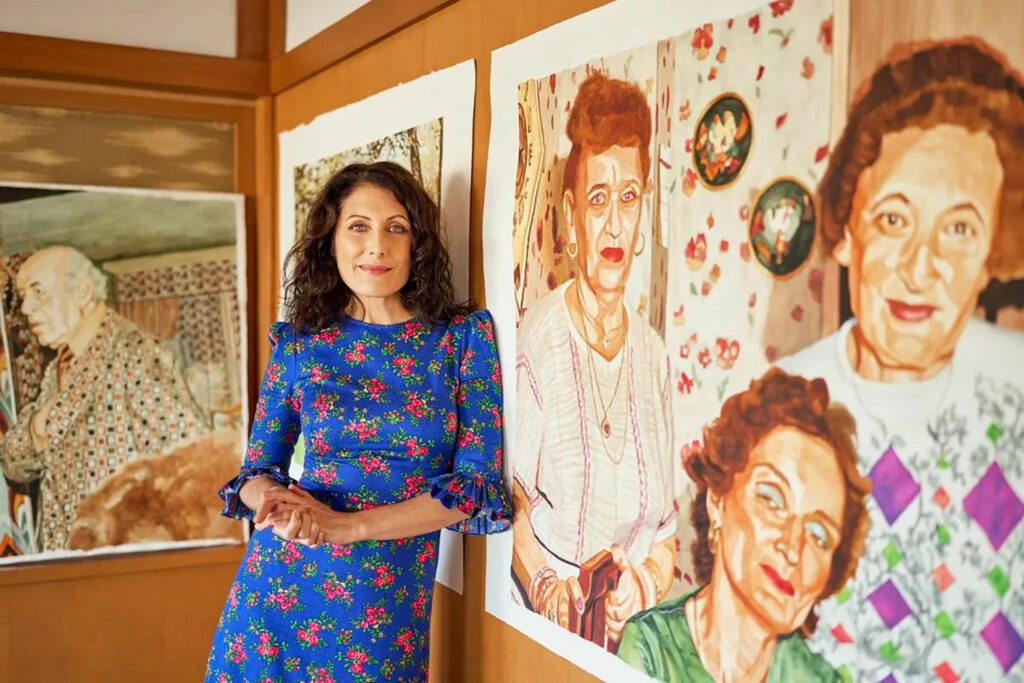
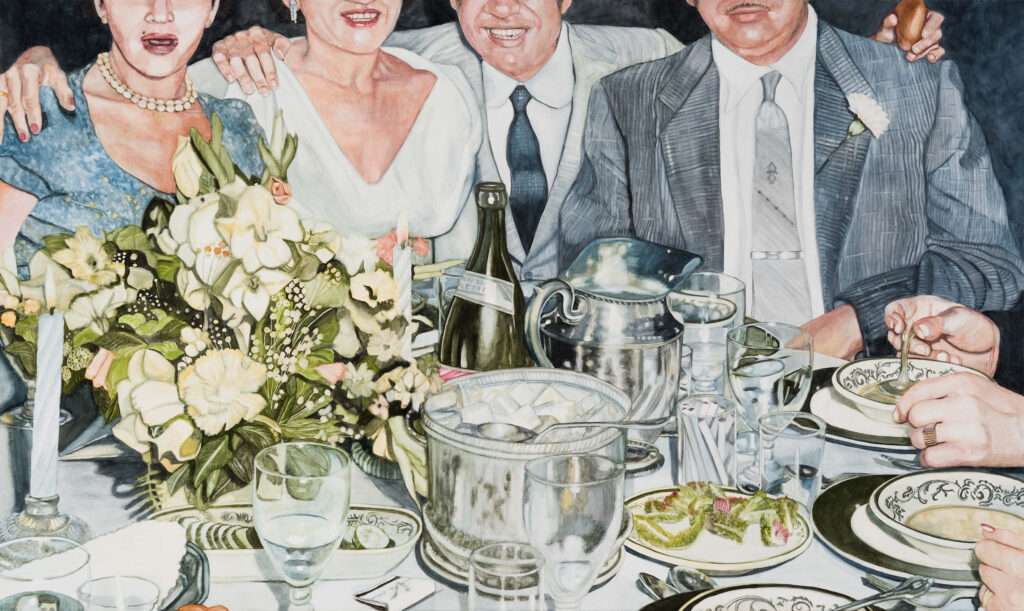
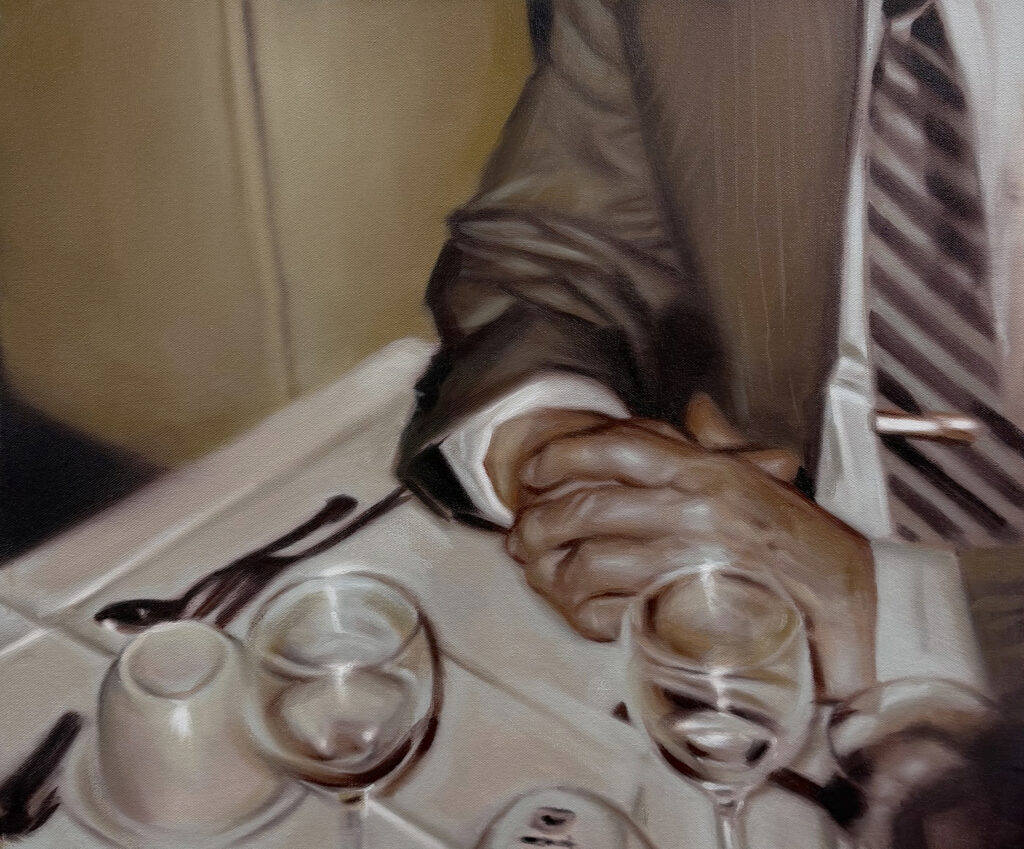
For inspiration, Edelstein turned to old family photographs capturing intimate moments of everyday life: a family meal; a woman with what looks like a kitchen towel on her head, saying the blessing over the candles; three Jewish women posing in a living room with floral wallpaper; and two men, one holding a large camera, again against that unmistakable ‘70s wallpaper.
“During COVID, I moved my parents closer to me because my dad was concerned that he was starting to decline, and all the things you think about when you are elderly,” recalled Edelstein. “My parents decided to downsize, and I inherited about 3,000 photographs. Initially, I was just using the material that I had available to me because we were in lockdown, and I was interested in sort of exploring the underbelly of suburban life in America.”
One of her favorite images she painted was of her mother, smoking a cigarette, drinking a Tab, and “looking miserable because she was stuck in this suburban place,” laughed Edelstein. “Those were like secrets told, and then there were certain Jewish images that came out because I come from a Conservative Jewish home, and certainly after October 7, there was the desire and need to really be proud and present this part of my story. It became more and more important to me.”
At first, Edelstein was worried about how her mother would react to seeing that small, private family photograph transformed into a large-scale painting and hanging on a gallery wall. But she said her mother didn’t seem to mind — perhaps because she looked beautiful in many of the paintings.
Edelstein’s parents have attended all her shows since 2023, when she had her first exhibition in New York. “It was the first time in my mom’s life that she felt like a celebrity,” said Edelstein.
Now, images of her mother, father, and extended family hang in other people’s homes — allowing these private family moments to become part of other families’ lives. After selling two paintings to friends, she sold her third to an art collector. At first, it was difficult for her to let go of these family portraits and sell the paintings, but eventually, she got used to the idea that, as an artist, that’s part of the process: letting others enjoy your work as well.
She also painted many images of Russell’s grandmother, and at least one of a younger Russell lying on the carpet, pen in hand, with a stereo and some records in the background.
While both artists focus on capturing moments in time, Edelstein’s work is intimate and narrative, exploring family and memory, whereas Russell’s paintings focus on individual objects — porcelain cups, a Shabbat teapot, a yahrzeit candle, and porcelain figurines. His meticulous attention to detail makes the objects appear so lifelike that you could almost swear they are photographs.
His porcelain figurine paintings carry a particularly fascinating and troubling history. They were produced by the Allach Porcelain Manufacturing Company, a German factory founded in 1935 and later controlled by the SS under Heinrich Himmler. These delicate sculptures — including puppies, lambs, rabbits, and idealized “Aryan children” — were originally created as decorative gifts and propaganda for the Nazi elite. During World War II, Jewish prisoners and other forced laborers at Dachau concentration camp were compelled to work under brutal conditions to manufacture these objects.
Russell approaches these figurines through large-scale still-life paintings, often based on auction photos of the few surviving pieces. By magnifying and rendering them in exquisite detail, he transforms objects that at first appear charming into potent reminders of their troubling origin.
Russell earned his Bachelor of Fine Arts (BFA) from the Rhode Island School of Design (RISD) and his Master of Fine Arts (MFA) from the California Institute of the Arts (CalArts), but he never received formal lessons or technical training beyond that.
One might assume that being married to an artist comes with the perk of informal art lessons, but as someone who believes artists should not be confined by conventional instruction, Russell supported his wife while deliberately avoiding coaching her on how to paint. Instead, he suggested artists she might explore for inspiration and encouraged her to seek out kindred spirits in the art world.
“You don’t want to stifle someone’s practice in any way,” he said. “The moment you start imposing technical achievements or the ‘right’ way of doing things, a project stops being a fun and exciting exploration and becomes just another task, like many other aspects of life. If there was something she really wanted to learn, then sure — but I can’t really teach it, I work very intuitively. Even though I have what a lot of people describe as a very technical facility, I wasn’t trained.”
Edelstein isn’t the first actor to also be a passionate artist — some are very good, others less so. Knowing that the art world and critics can be unforgiving, Edelstein admitted she was hesitant at first to show her work publicly.
“I was just scared, because when an actor really does anything besides acting, people don’t always like it,” she said. “I was just grateful that was not a part of the story, it was really just about what people were experiencing with the paintings themselves. A lot of them said that they found their own families in them.”
Her show at the Skirball will mark her fifth exhibition, and there are talks to move the joint exhibit to other galleries or museums. “I feel like the deeper you go into the personal, the more universal it becomes.” she said.
Their exhibition title, ‘Palace in Time’, was inspired by a phrase from Rabbi Abraham Joshua Heschel’s classic book The Sabbath, in which Heschel describes Shabbat not as a day of rest in the passive sense, but as an active way to make meaning out of the rest of the week.
Shabbat can be experienced, Heschel wrote, as a temporal space of sanctity that contrasts with the everyday rush of life and the material world.
“We thought the imagery referenced those types of gatherings, and we wanted the space itself to feel like a kind of palace in time for visitors. Since our kids were very little, we’ve been doing Shabbat at home,” said Russell, who has two sons from a previous marriage. “We’re not a ‘shomer Shabbos’ household or anything, but we have Shabbat dinners, and the boys know that on Friday nights we are all home together for dinner. I read that book a couple of years ago and it really resonated because he talks about Jewish ritual and the Sabbath in particular. As Jews, we build these sorts of invisible scaffolds around time to sanctify moments in our lives and to sanctify time itself.”
Visitors to the exhibit are invited into a world where memory, ritual, and everyday life converge. Edelstein’s intimate family scenes and Russell’s meticulously rendered objects act as portals to other times, prompting reflections on one’s own traditions and personal histories. In transforming private moments and ordinary objects into works of art, Palace in Time becomes more than an exhibition — it is an invitation to pause, to remember and to consider how the rituals we build around time shape who we are and what we choose to carry forward.
‘Palace in Time,’ the upcoming joint exhibition by actress-turned-artist Lisa Edelstein and her husband, renowned painter Robert Russell, at the Skirball Cultural Center May 20–September 6. For more information visit skirball.org