
Chef Shimi Aaron – Babka and Beyond

Babka and Beyond
Chef Shimi Aaron, LA’s babka king, reveals how creativity fueled his career journey and why Hanukkah is his favorite holiday.
By Jacqueline Fitzgerald
Taking leaps of faith comes naturally to Chef Shimi Aaron. Whether he’s making one of his famous babkas or preparing to host a Hanukkah gathering, he’s more likely to follow his heart than to follow the rules.
Growing up south of Tel Aviv in Holon, Israel, he knew two things at a young age: He wanted to live in America (he’d seen it on TV and was drawn to New York), and he wanted to create art. “I loved theater, I loved museums. I loved poetry and music,” he says. “I’ve always cooked, but I never thought that food would become my art. I never thought, ‘I’m good enough to get paid for it.’ I didn’t plan any of it.”
Instead, he explored opportunities as they presented themselves and did a fair amount of globetrotting in the process. Not a fan of formal education, he didn’t finish high school. He had a successful career in the jewelry business, working with Michal Negrin, and he lived in Tokyo and New York, with long stints in London, before setting up in Los Angeles.
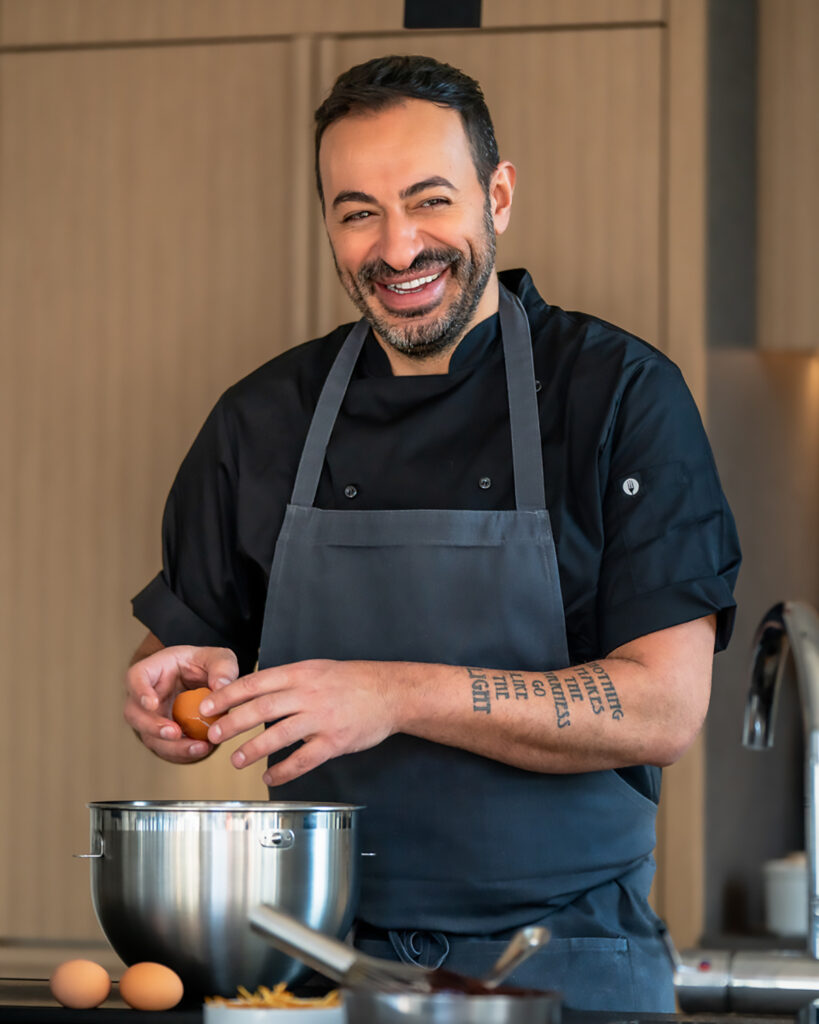
While in London around 2014, he began cooking Shabbat dinners for his cousin and her family. “They were so excited about my food that they decided to hire me to come every week,” he recalls, adding that he was seeking a new career direction. “I cooked for their friends as well. And slowly I started thinking, ‘OK, if I get paid for it, maybe that’s what I can do for a living.’”
One day, he became intrigued when he saw his cousin’s family’s nanny making babka. “I really fell in love with the aesthetics of it,” he confides. “I said, ‘I want to try it,’ and she gave me the recipe.”
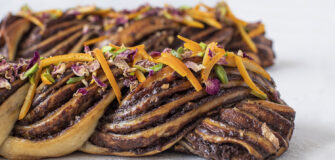
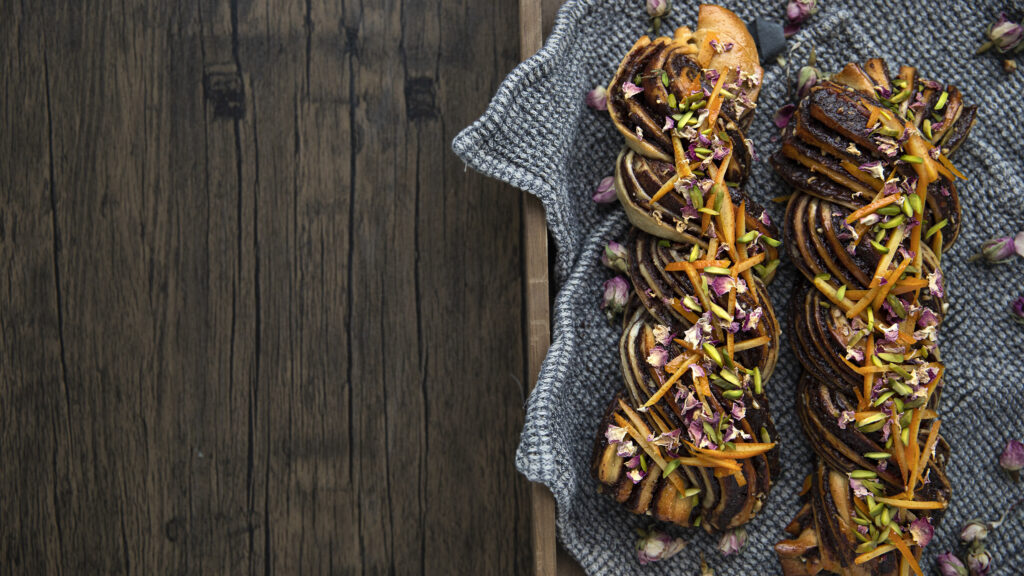
After all, as Elaine Benes (played by Julia Louis-Dreyfus) of “Sein feld” once proclaimed, “You can’t beat a babka.” But that doesn’t mean a babka can’t be improved. And Aaron did — changing the recipe and baking a dessert as visually dazzling as it was delicious.
His recipe calls for vegetable oil, not butter, for a lighter-tasting dough. And he adorned his version with candied orange and rose petals, both of which conjured memories for him.
“I used to make candied orange with my mom,” he says. “And I use the rose petals because it reminds me of my mom’s mother. My grandmother didn’t have money to buy perfume, so she used to wear rose water as perfume. Every time I smell it, it sends me back to being around her in the kitchen. I would escape school and go to her house. She wouldn’t care if I skipped school. We would bake pastries together and cook. I learned a lot from my grandmother.”
Years later, Aaron learned about the restaurant business while working for several years at Bala Baya in Southwark (London), which his friend, chef Eran Tibi, opened in 2017. Tibi promised to teach Aaron everything, under one condition: He zip his lip. “No one really tells me to shut up,” Aaron says, wryly. “It’s a very difficult thing for me to do. I’m opinionated about everything.”
Trusting his gut that he was on the right track with his culinary pursuits, Aaron decided to return to the U.S. and moved to Los Angeles in 2020. Before he left the UK, his babka garnered press coverage from BBC Food after an event in Budapest. He set up a website, started posting on social media, and began baking in a friend’s kitchen in Calabasas. “I literally took over the kitchen and sold maybe three to five babkas a week,” he says.
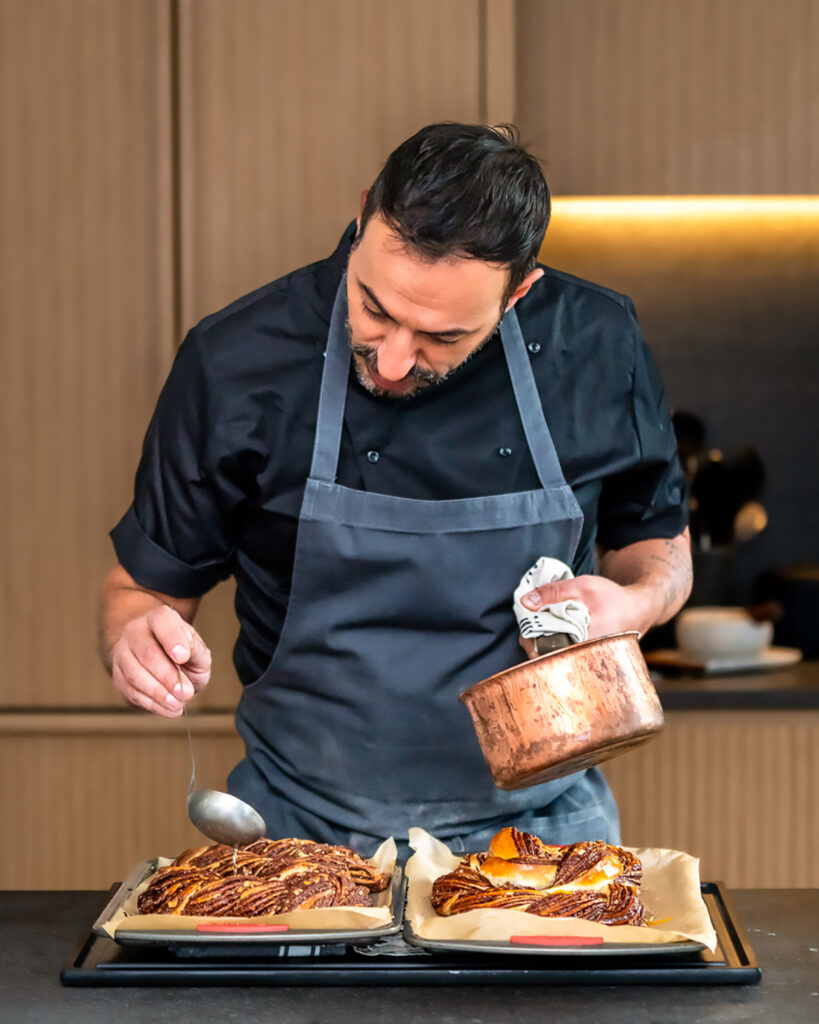
However, his business spiked after he snagged online and print stories in the Los Angeles Times (he was dubbed the babka king of Los Angeles.) “The Times print article was a whole page,” he says. “I was in tears. I was completely shocked, and I was freaking out. And then I found myself baking 200 babkas a week.”
Demand continued unabated, and he was able to move into his own place in Silver Lake. “I was living in a 400-square-foot apartment with a tiny kitchen,” he says. “I was sleeping around boxes of babkas. It was just insane. It’s still mind-blowing to me.”
Additionally, Aaron has earned acclaim as a private and personal chef. He also offers meal-prepping services, baking workshops and cooking demonstrations. For all his endeavors, visual inspiration is crucial. As he puts it: “We eat with our eyes. I don’t think you want to eat something that looks ugly.”
So, he strives to put beauty on a plate, literally. He explains: “Most chefs have ideas for dishes because they go to the farmers market and they see an ingredient. It’s completely different for me. I go to a store (such as Crate & Barrel, Sur La Table or Nordstrom) that sells crockery. I collect plates, glasses, cups, silverware, cutlery and napkins. When I see a plate that I like, right away, I’m already seeing it with the food I’ll be serving. This is how I think of a dish. It’s very strange.”
No doubt, his Hanukkah menu will be no exception. It’s his favorite holiday, and he appreciates Hanukkah’s feeling of happiness, whereas in his view, some Jewish holidays have a sad story behind them. “We won something — it was a war that we won,” he says. “We gained the temple back. And it feels very celebratory. There’s a sense of achievement, like we achieved something that was important and big.”
Looking at Hanukkah through the lens of childhood, Aaron has fond memories, though food wasn’t necessarily a major focal point. “Yemeni Jews don’t change their menu so often,” he says. “For a main course, we’d have chicken, or meatballs or fish. There was no different food in our house for Hanukkah. There was just the add-on of the sufganiot or zalabya, made with yogurt. I have a distinct memory of this smell of the doughnuts.”
One dish that wasn’t mentioned was latkes. “I grew up in a Sephardic house, and we didn’t have latkes,” he says. “But we had a lot of Ashkenazi neighbors, so I knew of latkes. My mom would do a similar dish (sometimes using zucchini), but she wouldn’t call them latkes. She would call them patties. I started using the word latkes only when I moved to America.”
On the first night, he says, the extended family would gather at his paternal grandmother’s house. “She was the most incredible person,” he recalls, noting that she passed away a year ago, at 105. “For her, the most important thing was family, and I think that’s what kept her alive so long. My dad was one of 10 children, and I’m the eldest of over 50 grandchildren and great-grandchildren.”
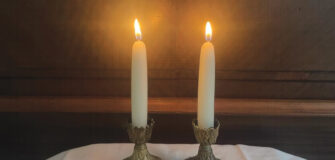
On subsequent nights, he would be with his parents, siblings, other relatives and friends. Says Aaron: “We took turns with lighting the candle. It was very important for us. We always wanted to light the candles.”
He says he particularly remembers the chocolate coins, which came in a “very, very ugly bag,” and the dreidel. “I’m a very competitive person, and we always turned the dreidel into a game.” Another treat: money from their grandparents. “Because I’m the eldest, I was always getting more than my brothers,” he says with a grin. “It felt great. And my birthday is December 22, so for me, Hanukkah was always magical. Then I moved to America, and it’s also Christmas. There’s so much to celebrate.”
Aaron says religion was important to him then and still is today. He and two cousins were named after their paternal grandfather, who was a rabbi. “He passed away when I was 6, but I have vivid memories of sitting on his lap,” says Aaron. “He would read the Torah to me and take me to synagogue. And I was going with my dad to synagogue.”
But as an adult, he says, he has his own way of believing in things. “You grow up and you have your own interpretation of everything. There was so much in religion I just don’t agree with, but I connect to things that are spiritual. I studied Kabbalah for 15 years to understand why, at some point, I was resentful of religion.
“In Kabbalah, there’s always a comparison to light. No matter how dark it is, the light is always there. It’s just concealed. And you have to remove the layers in order to reveal the light. That’s our job in the world as people, especially as Jews. There’s always this fight in life between light and darkness, which is very much connected to Hanukkah. There is a lot of light that’s being revealed on the days of Hanukkah. And I think you go on with the candles and each day you increase the light.”
The struggle between light and dark is a concept he reveres, to the point of having these words tattooed on his arm: “Nothing makes the darkness go like the light.” The words are lyrics from Madonna’s song, “Nothing Really Matters,” on her “Ray of Light” album. (A babka image is one of his other tattoos.)
And he holds fast to his Jewish cultural identity. Says Aaron: “We are one of the only religions in the world that is really maintaining its culture and heritage. We carry it with so much pride and joy. Even if you speak to the most non-religious Jewish person, they will talk about the culture in a passionate way. It’s a built-in thing. It’s almost like genes that I think we have within us. So, being Jewish is always going to be a very, very big part of my life.”
Perhaps it’s not surprising that Aaron ended up as a chef. In Jewish culture, he says, the kitchen is the center of the house, and he believes food has the power to heal people and change their lives. “It’s done both for me,” he says. “Cooking for people is something I’ve done my entire life. I was always in the kitchen. And I feel blessed that people think I’m worthy, that I get paid to cook for them. It’s incredible.”
Another blessing is realizing he has real roots in Los Angeles, even though, as a New Yorker, it took him some time to adjust to car culture. “I love my life here,” he says. “There’s something about Los Angeles that reminds me of Israel. Israel is a place I love, but I don’t feel the connection I used to feel. Every time I travel somewhere else, or I go and live somewhere else, I’m thinking, ‘I want to go back home.’ Home is here, in America.”