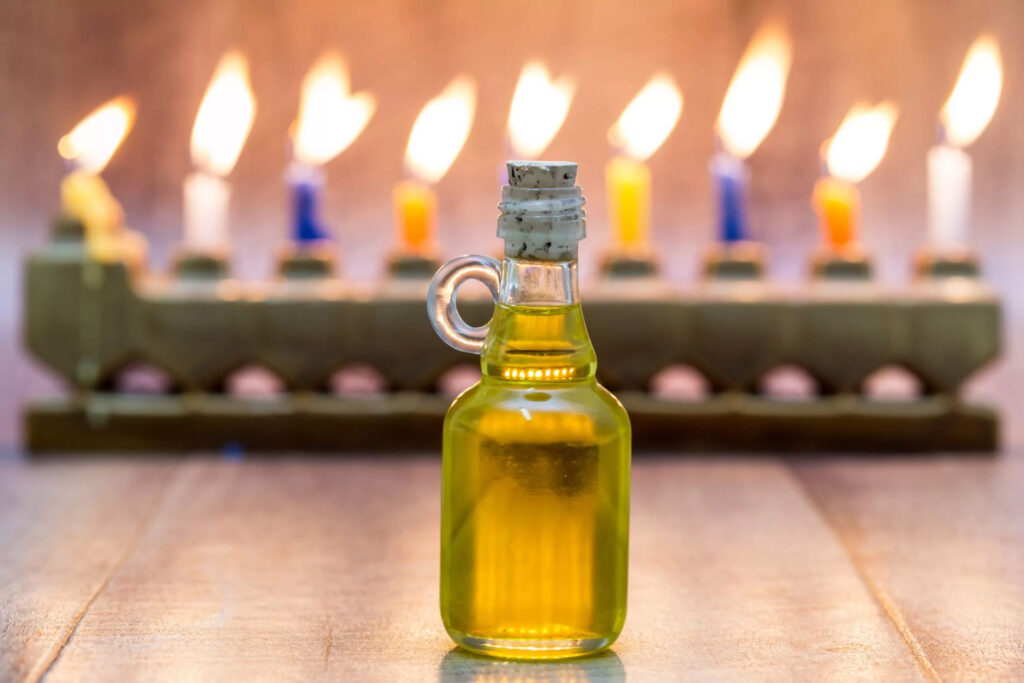
Every year, as we light the menorah, most of us tell the same story: A small jar of oil, enough for one night, burned miraculously for eight. That’s the miracle of Hanukkah. But here’s a surprise: The earliest accounts of Hanukkah are in the Books of Maccabees, which don’t mention oil at all. Those books appear in the Catholic and Orthodox canons, where the Hanukkah story takes on a very different tone.
In 1 and 2 Maccabees, we read about the harsh rule of Antiochus IV, the Jewish revolt led by Judas Maccabeus, and the dramatic rededica tion of the Temple. The eight-day celebration, according to the text, was modeled after Sukkot, which the people had missed during wartime. 2 Maccabees also highlights powerful stories of martyrdom, like the mother and her seven sons who chose death rather than abandoning the Torah. Hanukkah is a story of bravery, faith and national victory.
By the time of the Talmud centuries later, Jewish sages told the story differently. Living under Roman rule, they weren’t eager to glorify rebel lion. Instead, in Shabbat 21b, they asked: “What is Hanukkah?” Their answer was the miracle of oil.
This shift moved the focus from military strength to divine providence. Hanukkah became a holiday of light, faith and daily home ritual rather than battlefield heroics. The Maccabees remain in our prayers, but they are framed as agents of God’s will, not simply warriors.
For Christians, the Maccabees became symbols of steadfast faith, even martyrdom, paving the way for later religious heroes. For Jews, the story is a reminder that survival rests not on armies, but on miracles, learning, and God’s protection.
Both versions honor the same moment in history, but one emphasiz es courage in war, while the other celebrates the miracle of light.
Ma’oz Tzur (Rock of Ages)
After Adam Sandler’s The Chanukah Song and I Have A Little Dreidel, the next most popular Hanukkah song has to be Ma’oz Tzur.
The song dates back to the late 12th or early 13th century, and while we’re not sure who wrote it, the first letters of the first five stanzas spell Mordechai. This has led many to speculate that the composer was Mor dechai ben Yizhak Halevy, a Rabbi and poet who traveled from Iraq to Germany during that time period.
Written during the Crusades, the song is a recounting of the times of redemption in Jewish history, including the Exodus from Egypt, the end of Babylonian captivity, escaping persecution from Haman, and the battle of the Maccabees against Antiochus.
Stanza 1:
My Refuge, my Rock of Salvation! ’Tis pleasant to sing Your praises.
Let our house of prayer be restored. And there we will offer You our thanks.
When You will have slaughtered the barking foe.
Then we will celebrate with song and psalm the altar’s dedication.
Stanza 4:
The Greeks gathered against me, in days of the Hasmoneans.
They broke down the walls of my towers, and defiled all the oils.
But from the last remaining flask a miracle was wrought for the Jews.[d]
Therefore the sages of the day ordained these eight for songs of praise.
The song has been adapted over the years to various melodies. In more recent years, some have added a new stanza to reflect surviving new Jewish atrocities, including the Holocaust and even the Tree of Life shooting.