

Returning the Favor – Joshua Washington

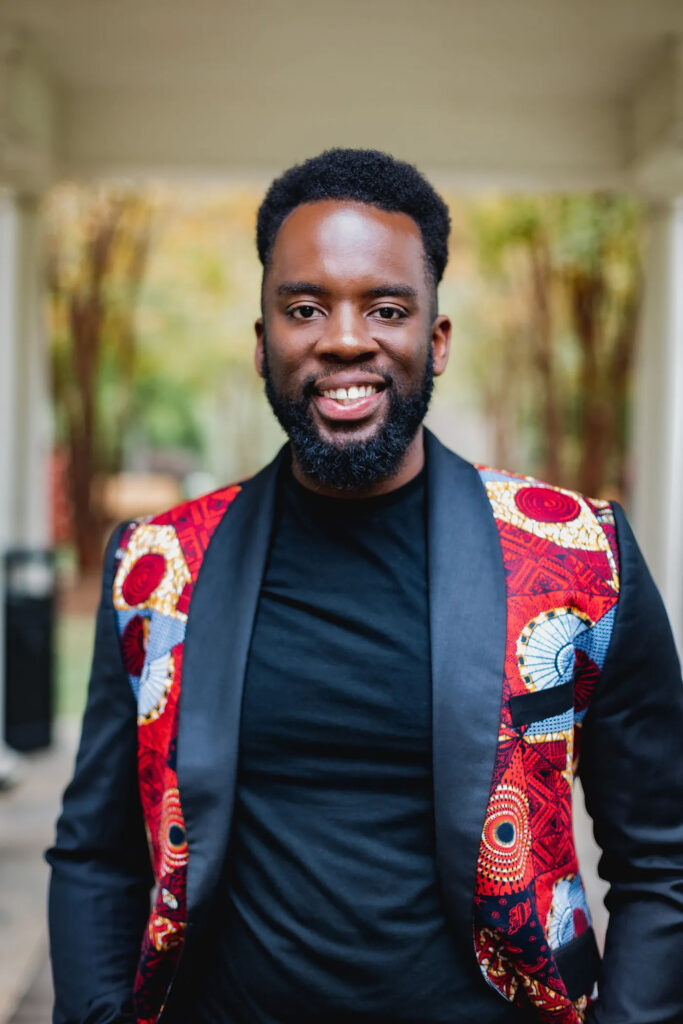
A Conversation with Cantor Lisa Peicott and Joshua Washington
On Dec. 14, Joshua Washington will take the stage at Wilshire Boulevard Temple for the concert debut of his brand-new Hanukkah album. It is a remarkable project that is written, composed and performed entirely by non-Jewish artists who proudly identify as allies of the Jewish community.
To explore the story behind this work, JLiving invited Lisa Peicott, Senior Cantor of Wilshire Boulevard Temple, to sit down with Joshua for a thoughtful and inspiring conversation about creativity, allyship and the power of music to build bridges.
Cantor Lisa Peicott: We’re excited for this awesome project, and I want to introduce Joshua Washington. Who are you, and what brings you to this moment?
Joshua Washington: I’m an artist, I’m an activist, I’m a composer, an arranger, singer-songwriter, and I love music. I love bringing people together. I love bringing cultures together. And what brought me here right now to this moment is my family’s love and close relationship with the Jewish community and with Israel.
I had this thought years ago to reciprocate this catalog of Christmas music that was written by Jewish composers. I had this idea of making original Hanukkah music by non-Jewish composers like myself and my co-producer, jazz pianist and composer Randy Sandoli, and calling it “Returning the Favor.”
Last December, when we first talked about it, I was in L.A. at Wilshire Boulevard, and I said it out loud, and it kind of shifted the whole room. And from there, we just started writing and writing, and now we have an album. I wasn’t sure if we were going to do the album this year because my wife had tragically passed away in January.
But around March, Randy reached back out to me and said, “Hey, I know there’s a lot going on right now with you, but if you’re feeling up for it, I really feel like finishing this project. It would be good for you and good for us.”
We took some time to think about it, and I said, “OK, I think we need to do this.” And we did. We made an album that, as we speak, is being mixed, and it’ll be mastered soon.
CLP: Aside from being a consummate performer, activist, and everything, in all of your free time, you’re also the Executive Director of the Institute for Black Solidarity with Israel, along with your father, Pastor Dumasani, who we’ve had on our bimah. Can you tell me a little bit about that organization and your connection to Israel?
JW: The Institute for Black Solidarity with Israel is an organization that focuses on Africa, Israel, and Black and Jewish relations, and we do that through education, advocacy and community engagement. And these concerts are part of what we do.
Our connection to Israel is something that started with my father when we were kids. He had always been fascinated with the roots of our faith. It was important to him, knowing that Christianity came from Judaism, and we wouldn’t have our faith if it weren’t for the Jew ish people. It started with this genuine fascination with him that grew into something that he became very knowledgeable about and would teach to us, and it was reflected in a lot of our music and in the way we practiced our faith.
One of the things he noticed was that there was this anti-Israel push coming from people who were trying to hijack the Black voice, and he wasn’t exactly sure what to do about it, but he knew from what he studied that what was being said wasn’t accurate.
I think the year was 2012, and he was in a library doing research, and he found some copies of a newspaper about an organization that was started in 1975 by Bayard Rustin (one of Martin Luther King Jr.’s right-hand men) called the Black Americans Supporting Israel Committee, or BASIC. It had over 200 signatures on it, people like Rosa Parks, Arthur Ashe, Leontine Price, Count Basie … These musicians, these political figures, everything. There were a lot of big names.
It really struck my father, and it pushed him to, first of all, put all this information online and continue in those footsteps of speaking the truth, speaking truth to power, and being that voice in the Black community that brings clarity to what’s going on from our vantage point.
CLP: Thank you for all that work, and to your father, and of course, to your late wife, Olga, who was an ardent activist. I’m wondering how, in writing a Hanukkah album as a Christian, as a Black man, how you brought your identity into these Hanukkah songs.
JW: I’m always inspired by the Hanukkah story. And I think it resonates with me because in a lot of ways, they’re these similar themes of being proud of who you are and not conforming. That’s a huge thing when I read the story.
There’s the Maccabees, and there’s this group of people who were like, no, we’re staying true to who we know we are, and in the face of all that.
That always resonated with me. One song that I did write was a tragic part of the story, but it resonated because it was like, even in the face of death, that’s what this woman and these seven boys who were with her decided to do. It hit me hard as a Black man and as a Chris tian, especially as my legacy I have behind me of civil rights stalwarts who stood in the face of death and harm for their rights, and the Jewish people who stood with them.
I felt like, you know, what a gift it would be to be able to give that back. There’s been so much cross-pollination of music. One of my favorite songs in general is “Strange Fruit.” Billie Holiday performed it, and it was written by Jewish writer and composer Abel Meeropol, and he wrote it after he saw a lynching.
It had nothing to do with his community. There was no one Jew ish involved in that, but it affected him so deeply that he wrote this poem that he sent to Billie Holiday, and they made it into a song. It is one of the most heart-wrenching tunes that America’s ever heard.
In that same spirit, I wanted to be a part of that tapestry of bringing our communities together through music in that way.
CLP: It’s no secret that right now is a very challenging time to be Jewish. A lot of people feel that there isn’t that allyship and that we’ve lost a lot of the community partners who walked alongside the Jewish community.
In this season of real trouble in this country and in Israel, that level of allyship isn’t just based on activism. It’s based on true empathy and understanding and seeing yourself as part of that story.
JW: I would say that true allyship is rooted in friendship. You have to have a relationship. You have to actually feel genuinely for the person next to you to effectively work with that person and be an ally.
CLP: And you have to know their story. Even when we’re talking about the Hanukkah album, you’re literally talking about the book of Maccabees, which most Jews don’t necessarily know because we focused on the story of the light and the miracle of Hanukkah. But there’s a deeper historical tie to either the choice to conform or not to conform.
On the album, what’s the song that sticks out the most in your mind, or is the most meaningful in your mind, and why?
JW: It’s one that Randy Sandoli wrote called “Light Will Dawn,” and it’s such an uplifting song. I think he did a good job of painting the picture of Judah Maccabee’s father, Mattathias.
The father is lamenting the temple being taken over, but then the chorus of the song is, “Light will dawn in the dark, light will dawn for the upright, for the one who is gracious, compassionate and just.”
And it’s such a good job of painting musically. It gets a little bit dark at the beginning, and then the chorus opens, and it gives that hope of the light is coming. Whenever I listen to it, it gives me chills.
CLP: Can you tell me a little bit about the musical influences, because as artists, we always bring who we are into the music we create.
JW: I have quite a few. My biggest influences range from different genres — from Stevie Wonder to Earth, Wind & Fire to Simon & Gar funkel. I have that singer-songwriter type of feel. You’ll hear a few different influences on this short album. And we have a kids’ choir on a couple of the tracks as well, which is also nice and fun.
CLP: The youth choir is very excited to sing on this. They’re ready for their big moments.
JW: And I’m excited to hear them.
CLP: What is your favorite Hanukkah song?
JW: There’s this old Israeli folk Hanukkah song called “Tiny Candles,” by Miriam Abigail. We actually covered that and put it on the album. It was so touching to me, and that’s what inspired me to put a kids’ choir on the album, because there’s a kids’ choir on that song.
CLP: It’s all about the future, right? Who are you passing it down to if you don’t have the future there?
JW: I remember listening to it. It’s all in Hebrew, and before I knew the translation, I had goose bumps. Whatever they’re singing about is doing something to me. So I looked it up, and it’s one of those uplifting bits of music that is born out of struggle.
CLP: You had mentioned in your intro that Jew ish lyricists and composers were part of making the canon of American Christmas music, American holiday music. And they each brought their own flavor and what they knew into those compositions. What is your favorite of those Christmas holiday albums, and why?
JW: There are so many good ones. My favorite is one that I covered several years ago, “Chestnuts Roasting on an Open Fire,” by Mel Tormé. I did an arrangement that was more bossa nova with the string quartet
CLP: Do you know the story behind the chestnuts? It’s a great one. It was a really hot day in Hollywood. Imagine Beverly Hills in the heat of summer. These are guys who grew up in New York. I don’t even know if there was an air conditioner or if it was broken. It was so hot in the apartment that they literally started writing things that made them think of being cold, like chestnuts roasting on an open fire, Jack Frost nipping at my nose.
JW: That’s amazing.
CLP: What goes into creating a concert? You’re doing this in Chica go. You’re doing this with us in Los Angeles.
JW: In Chicago, we’re performing at Pastor Corey Brooks’ New Beginnings Church. The first step is getting support. We were lucky enough to have raised funds for both places. It’s really community-building, because it all has to be based on relationships. A lot of the church, and we have pastors and rabbis who are going to be a part of the program.
Like you said, when everything is so hyper-divisive, and it’s hard to get any kind of point across without being attacked or shot down, it proves that most people want to live in harmony with each other. Most people crave community and relationships, and it’s proving that in a very easy way.
CLP: We’re ready for understanding and empathy and love, which I believe is the core of who we are. And I think music has an ability to remind people of that core place of humanity.
JW: Absolutely. Totally.
CLP: We’re so excited for this concert, and I’m excited to just be on the bimah with you and to see you in action.
Joshua Washington’s concert is scheduled to take place on Sunday, Dec. 14, at Wilshire Boulevard Temple’s Resnick Campus, located at 11960 West Sunset Boulevard in Los Angeles.