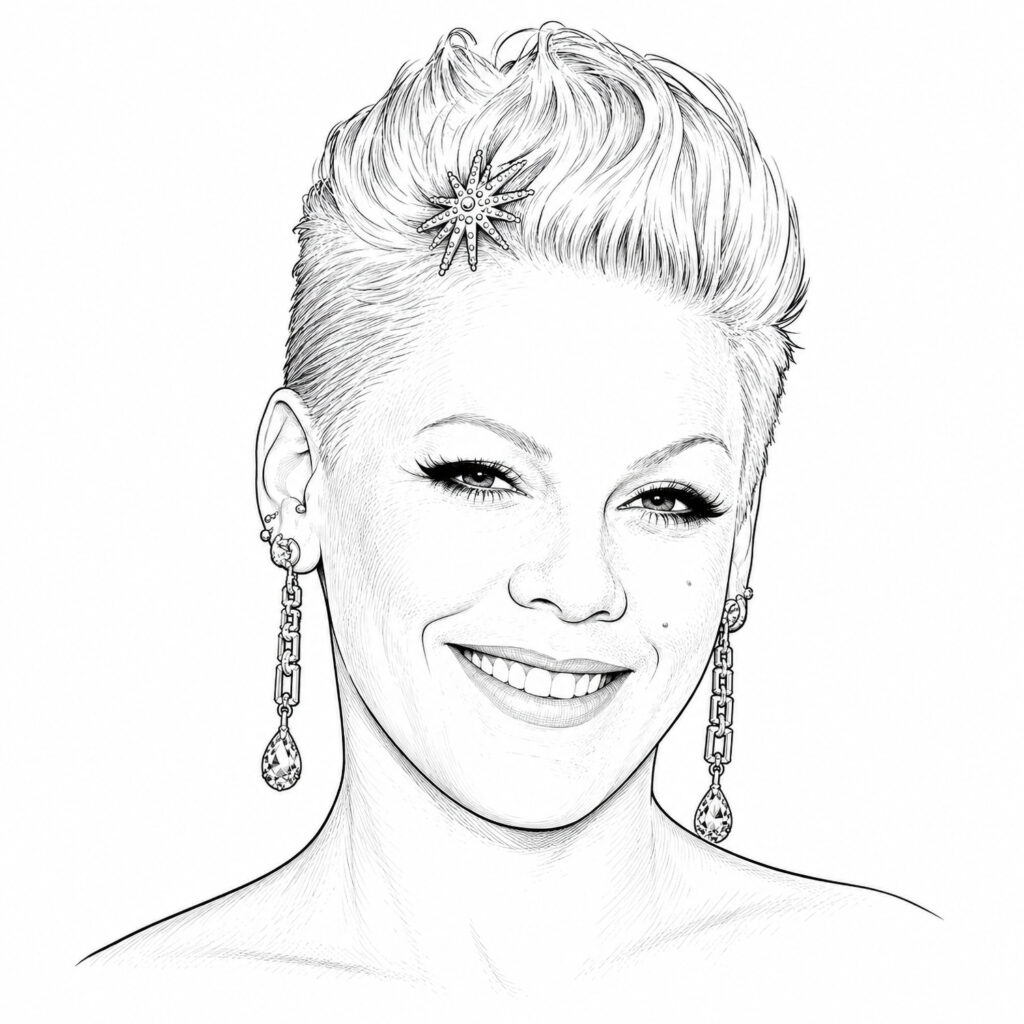
Pink, born Alecia Beth Moore to a Jewish mother, Judith Kugel, grew up in Pennsylvania and built one of the most durable careers in contemporary popular music: nine studio albums, dozens of Grammy nominations, three wins, and an audience of millions that spans generations and continents. She has also, throughout that career, been stubbornly, publicly, unapologetically Jewish in ways that a music industry often skittish about identity has not always made easy.
She bakes challah with her mother. She lights the Hanukkah candles with her children and shares it with her followers. She has described herself as an “Irish-German-Lithuanian-Jew” with the casual confidence of someone for whom that hyphenated identity is simply a fact of life, not a complication to be managed. Her Jewishness is not a statement. It is just who she is. But when the world demanded a statement, she gave one.
In 2017, while headlining a concert in Berlin, she watched neo-Nazis march in Charlottesville, Virginia on the screens of her phone. She took to Instagram to process the surreal horror of it: a Jewish woman performing in Berlin, reading about swastikas marching through American streets. It was not a carefully crafted public relations response. It was a human being refusing to pretend that everything was normal. That same year, she brought her daughter Willow to the Holocaust Memorial Museum in Berlin during her Beautiful Trauma tour, pointed at the exhibits, and said: this could have been us.
In 2023, when a social media commenter accused her of being “tone deaf” for posting a Hanukkah photo amid rising conflict in the Middle East, her reply became a rallying cry across the Jewish internet. Short, sharp, and perfect: “Tone deaf to be Jewish? Or alive?” Four words that said everything that needed to be said and said it to an audience of sixty million people.
That number matters. Every time she lights candles on camera, bakes challah on a story, or fires back at a bigot in the comments, she is making Jewish identity visible, joyful, and defiant to an audience larger than most countries.
It is simply part of who she is, part of what she does, expressed with the same directness and lack of apology that runs through everything she makes.
““Tone deaf to be Jewish? Or alive?” — Pink, responding to an antisemitic social media comment, December 2023”
Pink did not set out to be a Jewish activist. She set out to be a musician. But she understood, intuitively and early, that who you are does not stop at the edge of your professional identity. She has carried her Jewishness into her career not as a liability to be managed but as a part of herself to be celebrated. In doing so, she has given millions of young Jewish fans something they did not always know they needed: the image of someone famous, successful, powerful, and loudly, joyfully Jewish. That is not a small gift. It is a very large one. And she gives it every time she shows up, every time she lights a candle on camera, every time she refuses to stay quiet.